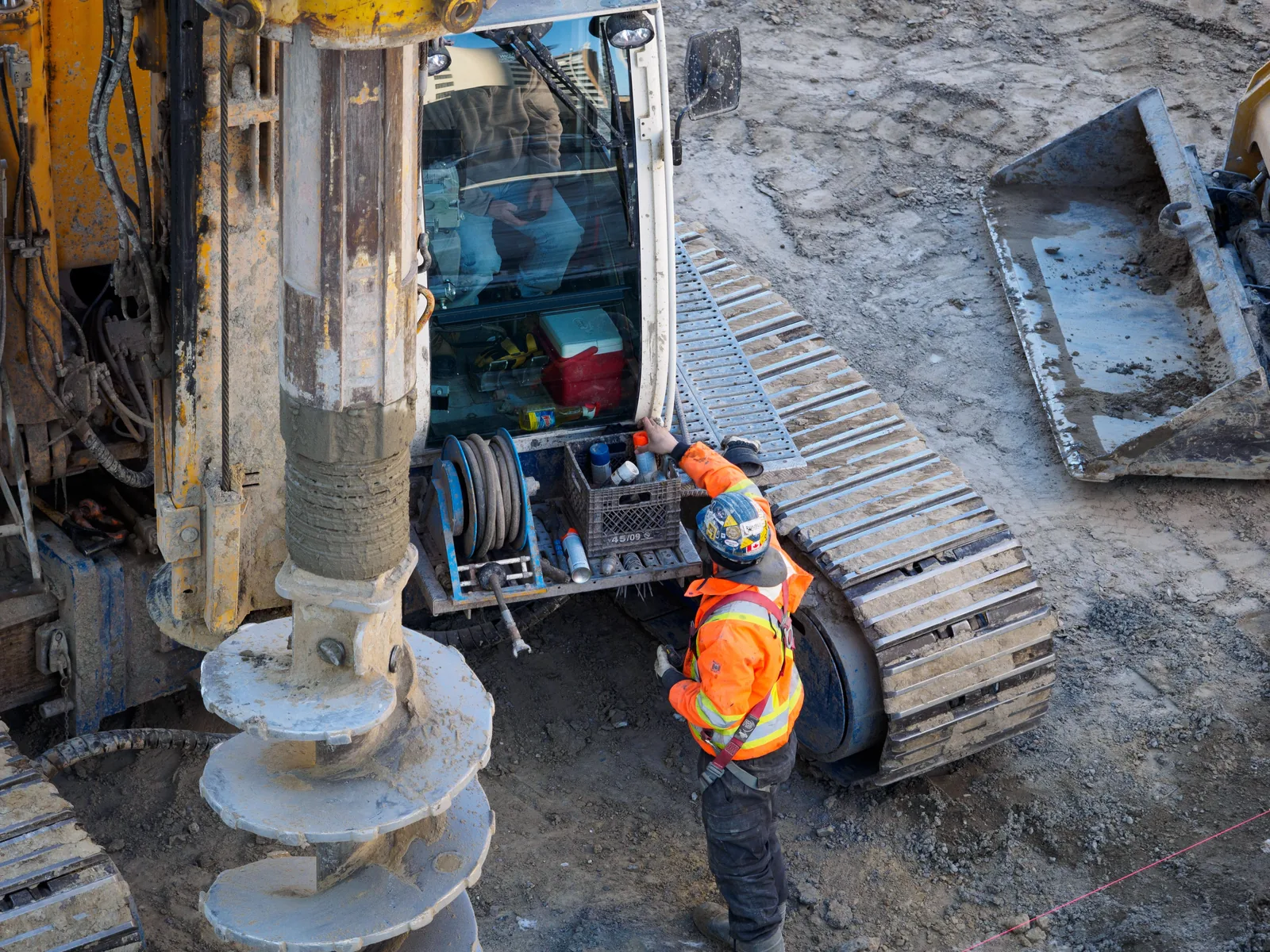
Continuous flight auger piling is the go-to method for commercial schemes across the North West: fast to install, quiet enough for city centres, and strong enough for multi-storey loads.
How CFA piling works
A hollow-stemmed auger drills to the design depth in one continuous motion. As the auger withdraws, concrete is pumped down the stem under pressure, so the bore is never left open. A steel reinforcement cage is then plunged into the wet concrete. The result is a high-capacity cast-in-place pile with minimal noise and vibration.
Because the bore is supported by the auger at all times, CFA works well in ground that would collapse an open bore — including the water-bearing sands, gravels and soft clays found across the region's river valleys.
Where CFA is the right answer
- Housing developments and apartment blocks with high pile counts.
- Industrial and commercial units along the M6, M62 and M56 corridors.
- City-centre and infill sites where vibration must be kept low.
- Schools, healthcare and retail schemes on brownfield land.
- Sites where programme matters — a CFA rig can install 15 to 25 piles a day in good conditions.
Typical specification
| Pile diameters | 300mm – 600mm |
|---|---|
| Typical depths | 8m – 25m+ |
| Working loads | 300kN – 1,500kN+ per pile |
| Daily output | 15 – 25 piles (site dependent) |
| Testing | Integrity testing as standard; static or dynamic load tests where specified |
Working with your team
Send the pile schedule, foundation layout and site investigation report and we will return a fixed, itemised price. Where no pile design exists yet, we offer contractor-designed piling: give us column loads and the SI, and our engineers produce the pile design for approval.
Every contract comes with RAMS, insurance documentation, daily pile records and as-built layouts — the paper trail your engineer, warranty provider and building control expect.
Where we work
Our teams cover the whole North West, with local crews in:
Frequently asked questions
What does CFA stand for?
CFA means continuous flight auger. A hollow-stemmed auger drills to depth, concrete is pumped through the stem as the auger withdraws, and a reinforcement cage is placed into the wet concrete. The result is a strong cast-in-place pile with very little vibration.
When is CFA piling the right choice?
CFA suits commercial schemes, apartment blocks and larger housing developments where pile numbers are high and neighbours are close. It is quick, quiet and works well in most North West clays, sands and gravels.
What size are CFA piles?
Common diameters run from 300mm to 600mm, with depths regularly beyond 20 metres where loads demand it. Your structural engineer's pile schedule sets the final specification, and we price directly from it.
Is CFA piling suitable near existing buildings?
Yes. Because the ground is drilled rather than hammered, CFA produces minimal vibration, which is why it is often specified on infill plots and city-centre sites close to occupied buildings.